
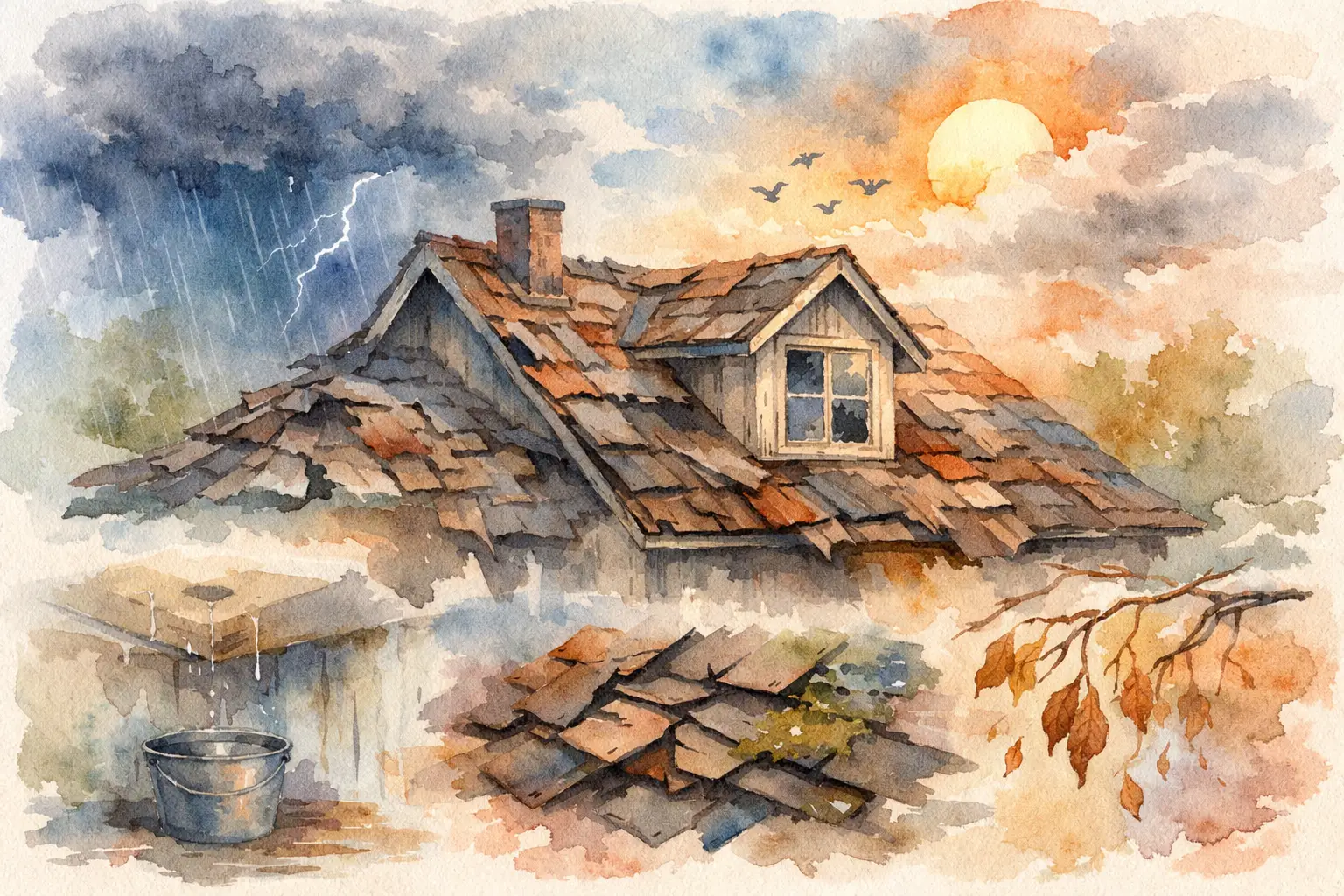
A roof rarely fails all at once. More often, it gives you fair warning – a damp patch in the loft, slipped tiles after strong wind, bits of mortar in the gutter, or a repair that seems to hold for a month and then fails again. If you are noticing these problems, the signs you need a new roof may already be there.
For homeowners, landlords and commercial property owners, the real question is not just whether the roof has a problem. It is whether that problem is still worth repairing, or whether replacement will save money, stress and repeat disruption over time. A proper inspection gives the clearest answer, but there are several warning signs that should not be ignored.
Common signs you need a new roof
Some roofing faults are isolated and straightforward to fix. Others point to wider deterioration across the whole system. The difference matters, because patching a roof that has reached the end of its life usually becomes a false economy.
1. The roof is getting old
Age on its own does not mean immediate failure, but it does set the context for every other issue. If your roof is several decades old and original materials are still in place, recurring defects become more significant. Slate can last a long time if it has been well maintained, while tiled roofs and flat roofing systems have their own expected lifespan depending on materials, installation quality and exposure to weather.
In Cumbria and the Borders, roofs often deal with heavy rain, strong winds and long periods of moisture. That constant exposure can shorten service life, especially if previous maintenance has been delayed. An older roof with new leaks, slipped coverings or failing ridge lines deserves closer attention than a newer roof with a single isolated fault.
2. You have recurring leaks
A one-off leak is not always a sign of full roof failure. It could be cracked flashing, a localised break, or a problem around a chimney or valley. But if leaks keep returning, appear in different places, or continue after multiple repairs, that usually points to a broader issue.
Water does not always enter directly above the visible stain, which is why repeat leaks can become expensive to chase. Once underlay, battens or roof timbers begin to suffer, the problem moves beyond surface repair. At that stage, replacing the roof may be the safer and more cost-effective route.
3. Tiles or slates are missing, cracked or slipping in several areas
A few damaged tiles after a storm can often be replaced without major work. What matters is scale. If you are seeing slipped, cracked or missing coverings across multiple slopes, or if the same sections keep failing, the roof may no longer be secure as a whole.
This is especially true if fixings have weakened over time or the roof structure has begun to move. A roof should protect the property consistently, not require constant attention after every spell of bad weather. Widespread movement is one of the clearest signs you need a new roof rather than another temporary repair.
4. The ridge tiles or mortar are breaking down
Ridge lines take a lot of weather exposure, and once mortar starts cracking or breaking away, water can get in and tiles can become unstable. In some cases, ridge repairs or repointing are enough. In others, failing ridges are just one visible symptom of general roof fatigue.
If mortar is dropping into gutters, ridge tiles feel loose, or the same areas keep needing attention, it is worth looking at the full condition of the roof. When several components are deteriorating together, replacing the system often gives better long-term value than repairing each issue one by one.
Internal signs the roof may be failing
Roofing problems are not always first spotted from outside. Quite often, the earliest clues show up indoors.
5. There are damp patches, mould or staining in the loft or on ceilings
Ceiling marks are never something to ignore. Even small stains can signal ongoing water entry, and moisture trapped in a loft can lead to mould, insulation damage and timber decay. If the marks get darker after rain or spread over time, the roof needs prompt attention.
That does not always mean complete replacement, but it does mean the roof is no longer doing its job properly. A professional assessment can tell you whether the issue is localised or whether moisture is entering through several weak points.
6. Daylight is visible through the roof structure
If you can see daylight in the loft through the roof covering or around joints that should be sealed, water and cold air can get through as well. Small gaps may result from slipped materials, deteriorated underlay or structural movement.
A roof should provide a continuous barrier against the weather. Once that barrier is compromised in multiple places, patch repairs become less reliable. This is particularly concerning in older properties where hidden timber damage may already have begun.
7. Your energy bills are climbing without another clear cause
Not every insulation problem starts at roof level, but a failing roof can contribute to heat loss and moisture problems that make the building harder to keep warm. If your upper rooms feel colder, draughtier or more prone to condensation, the roof may be part of the issue.
This point needs a bit of balance. Rising energy bills alone do not prove you need a replacement roof. Poor ventilation, insulation gaps or window issues can also be involved. Still, when energy loss appears alongside visible roof defects, replacement becomes a more realistic consideration.
Structural and surface issues that should not be left
Some signs are less about obvious leaking and more about the roof beginning to lose its shape and reliability.
8. The roofline is sagging or uneven
A sagging roofline is a serious warning sign. It can indicate long-term water ingress, weakened timbers, overloading, poor past workmanship or age-related structural decline. This is not something to monitor casually or leave until later.
Even if there is no major leak yet, movement in the structure means the roof is under strain. Depending on the cause, repairs may still be possible in a limited area, but widespread sagging often points to the need for a more substantial replacement project.
9. Flat roofing is blistering, cracking or pooling water
On flat roofs, deterioration often looks different. Instead of slipped tiles, you may notice bubbling, splits, lifting seams or standing water that does not drain properly. Small isolated faults can be repaired, but once a flat roof starts failing across its surface, patching tends to become repetitive.
Pooling water is especially worth watching. It adds stress to the roof surface and increases the chance of water finding its way through weak points. If a flat roof is ageing and showing multiple defects, replacement is often the sensible answer.
10. Repairs are becoming frequent and costly
One of the biggest practical signs you need a new roof is simple: you keep paying to fix it. Many property owners try to stretch a roof for as long as possible, which is understandable. A targeted repair is cheaper upfront than a full replacement.
But if you are booking repeated call-outs, dealing with fresh leaks, replacing more tiles every year, or worrying whenever the weather turns, the running cost adds up quickly. At some stage, a new roof stops being the expensive option and starts being the economical one.
When repair is enough and when replacement makes more sense
There is no single rule that fits every roof. A newer roof with storm damage in one section may only need a proper repair. An older roof with widespread wear, repeated leaks and failing mortar may be better replaced in full. The best decision depends on the age of the roof, the extent of deterioration, the condition of the structure underneath and how often problems are returning.
This is where honest advice matters. A dependable roofing contractor should tell you if a repair is worthwhile and also tell you when it is not. There is no benefit in carrying out patchwork that leaves you facing the same issue again next season.
For many property owners, timing matters too. If the roof is not in immediate danger but is clearly nearing the end of its life, planning replacement before a major failure gives you more control over budget, schedule and materials. That is usually better than waiting for an urgent leak in the middle of winter.
What to do if you recognise these warning signs
If several of these issues sound familiar, do not rely on guesswork from ground level. Roof problems often look smaller than they are, and sometimes they look worse than they are. A proper inspection is the only way to understand whether the roof needs a local repair, more extensive remedial work or full replacement.
For property owners across Carlisle, Cumbria and nearby areas, acting early can prevent damage to ceilings, insulation, timbers and interior finishes. It also gives you the chance to compare options properly instead of making a rushed decision after the next storm.
A good roof should give you confidence every time the weather turns. If yours is doing the opposite, it may be time to stop paying for short-term fixes and start thinking about a lasting solution.